
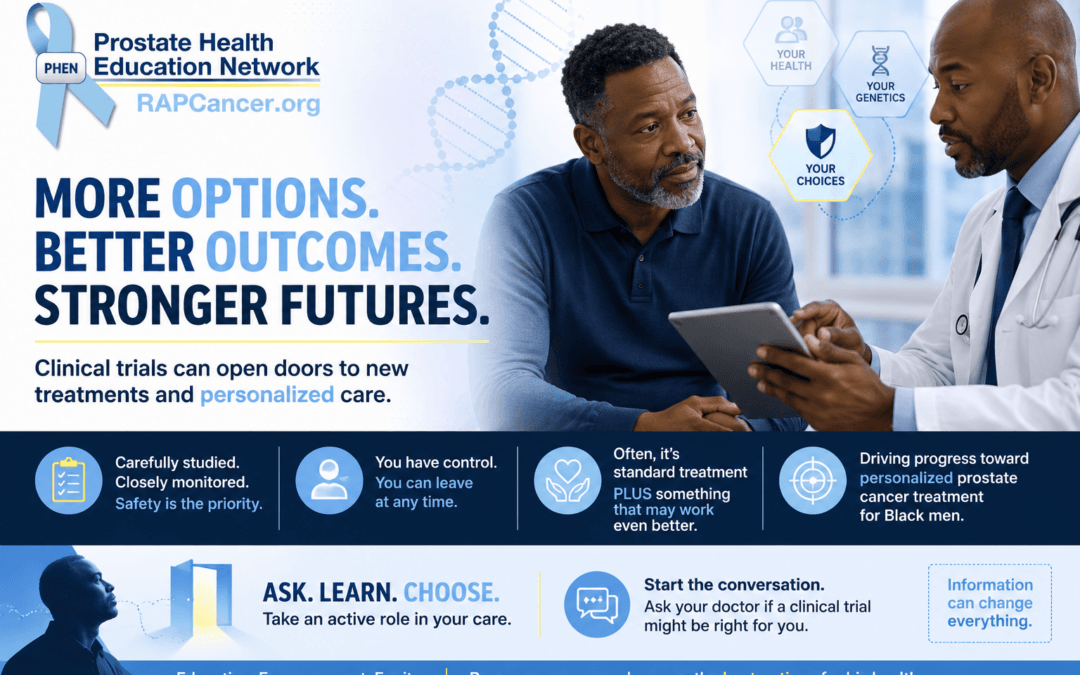
When you hear “clinical trial,” what do you think? For a lot of men, the words clinical trial can feel uncomfortable or even frightening.
Instead of hope, a clinical trial can sound:
- Like a last resort.
- Like you’re being experimented on.
- Like you’ve run out of better options.
That fear is real and common, especially among men of African descent, given the history of medical mistrust and unequal access to care.
That’s why trust-building, transparency, and clear communication are essential when discussing treatment options and clinical trials.
Here’s the truth: Clinical trials are not about being a test subject.
They’re about:
- Access to newer treatments.
- Access to more personalized prostate cancer treatment.
- Access to options that may not exist anywhere else yet.
And for many men, they’re worth understanding before you need them.
What a Clinical Trial Actually Is (In Plain Language)
A clinical trial is a carefully designed research study that tests new ways to prevent, detect, or treat disease.
That could mean:
- A new medication
- A different combination of existing treatments
- A more precise way to target cancer based on your genetics
Every trial follows strict protocols. Nothing is casual. Every step follows a carefully designed plan, and some trials use random assignment to fairly compare different treatment approaches.
Before joining a trial, patients go through an informed consent process where the study, possible risks, potential benefits, and alternatives are explained clearly.
Before a treatment ever reaches a clinical trial, it has already gone through years of lab research. By the time patients are involved, safety is the priority and it’s closely monitored at every step.
Why This Matters More for Men of African Descent
Prostate cancer doesn’t affect everyone equally.
Black men are more likely to be diagnosed. More likely to be diagnosed at a later stage. And more likely to die from the disease.
That’s why conversations around prostate cancer awareness and treatment for men of African descent can’t stop at screening; they also have to include access to better options.
Here’s the problem:
Black men have historically been underrepresented in clinical trials.
Which means:
- Less data on how treatments work specifically for them
- Fewer insights into side effects
- Gaps in what truly “personalized” care looks like
Greater participation in clinical trials can help researchers better understand how treatments work across different populations and improve future care.
The Question Most People Don’t Ask: “Is This Right for Me?”
You don’t have to be out of options to consider a clinical trial.
In fact, some trials are available:
- Right after diagnosis
- Alongside standard treatments
- Before symptoms even progress
Timing matters.
The sooner you ask questions and understand your options, the more say you have in what happens next.
Eligibility for a clinical trial depends on factors such as your diagnosis, stage of cancer, prior treatments, overall health, and the specific requirements of the study.
What About Safety, Risks, and Control?
This is where most of the hesitation comes from and it’s valid.
But here’s what you should know:
- You can leave a clinical trial at any time.
- Before you join, everything is explained clearly, including risks and possible benefits.
- You’ll be closely monitored.
- Participation is always voluntary, and you have the right to ask questions before making a decision.
And usually, it’s not a choice between regular treatment and a trial.
In many clinical trials, standard treatment remains part of the care plan, although the exact design depends on the study.
It’s more like choosing between:
- Regular treatment by itself
- Or regular treatment plus an investigational treatment that researchers are studying to see whether it may improve outcomes
That difference is important.
Clinical Trials and Personalized Prostate Cancer Treatment
One of the biggest shifts in cancer care right now is personalization.
Not every prostate cancer is the same. Not every man responds the same way to treatment.
Clinical trials are driving advances like:
- Targeted therapies based on tumor genetics
- Immunotherapy approaches that use your own immune system
- Treatment plans shaped by how aggressive your cancer really is
Biomarker or genetic testing may also help identify clinical trials that match specific features of your cancer.
For men of African descent, this is especially important.
Because improving outcomes means moving beyond one-size-fits-all care, and clinical trials are where much of that progress happens.
How to Start the Conversation Without Feeling Overwhelmed
You don’t need to walk into your next appointment with all the answers.
You just need a better question.
Try this:
“Are there any clinical trials that might be a fit for me right now?”
That one question can open the door.
From there, you can ask:
- What’s the goal of the trial?
- How does it compare to standard treatment?
- What would participation actually look like day to day?
- Can resources such as PHENTrials.com help me learn about clinical trials that may be worth discussing with my doctor?
If something doesn’t feel right, you can say no.
But if you never ask, you may never know what was possible.
This Isn’t Just About Research. It’s About Your Options.
A prostate cancer diagnosis can turn everything upside down in an instant.
One moment you’re processing the news, and the next you’re sitting in appointments, hearing options, and feeling the pressure to make decisions before you’ve had time to catch up.
It’s a lot. And it’s happening fast.
Your voice and choices matter.
Clinical trials aren’t the right path for everyone.
But they’re something everyone deserves to understand, especially when you’re looking at the full picture of prostate cancer treatment options for Black men.
Because when you understand what’s truly available to you, something shifts.
You’re not just going along with what’s in front of you.
You’re choosing.
And that changes more than the direction of your care.
It changes how you feel through your treatment.
Informed Decisions Start With Better Conversations
Clinical trials aren’t something to fear or ignore.
They’re something to understand.
For men of African descent, the gap in outcomes is real, and closing that gap requires better access, better data, and better conversations.
If you or someone you love is navigating this journey, don’t stop at the basics.
- Ask about prostate cancer clinical trials for Black men.
- Ask about personalization.
- Ask what else might be possible.
- Ask whether genetic or biomarker testing could help guide treatment or identify clinical trial opportunities.
PHENTrials.com provides easy access to clinical trials for all prostate cancer diagnoses. Patients can identify and review trials that may be appropriate for them.
Because the right information can change everything that comes next and support informed decision-making at every step.